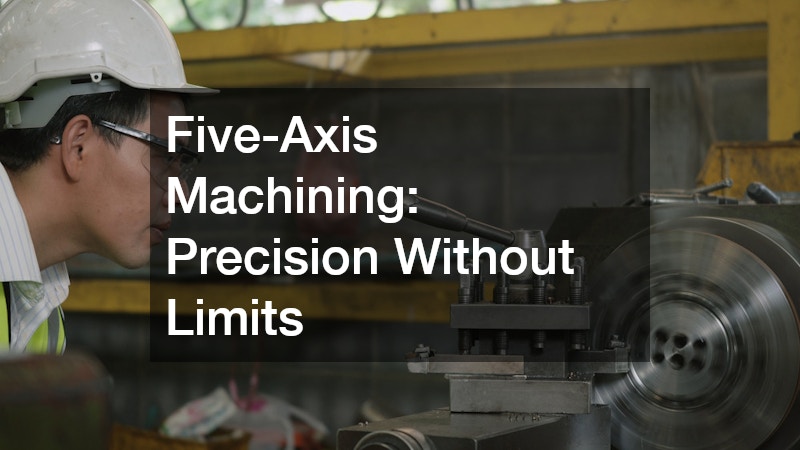
The manufacturing world has always been driven by the pursuit of greater precision, faster production, and the ability to create increasingly complex parts. Five-axis machining represents a major leap forward in achieving all three. This advanced technology enables manufacturers to overcome traditional limitations, producing intricate components with unmatched accuracy and efficiency.
As industries demand tighter tolerances and more sophisticated designs, five-axis machining has become a critical solution. In this article, we’ll break down what five-axis machining is, how it works, its benefits, challenges, and what the future holds for this powerful manufacturing method.
What is Five-Axis Machining?
Five-axis machining is a CNC (computer numerical control) process in which a cutting tool moves along five axes simultaneously. In addition to the traditional X, Y, and Z linear axes, the machine also rotates along two additional axes, allowing the tool to approach the workpiece from virtually any angle.
This capability significantly reduces the need for multiple setups and repositioning, making the process both faster and more precise.
The Evolution of Machining Technology
Traditional machining began with manual mills and lathes, evolving into CNC machines that automated movement along three axes. While these advancements improved consistency and efficiency, they still required multiple setups for complex parts.
Five-axis machining emerged as the next step, enabling continuous movement and multi-angle cutting in a single operation. This evolution has reshaped industries that rely on precision engineering.
Applications in Modern Manufacturing
Five-axis machining is widely used in industries where precision is critical, including:
- Aerospace
- Medical device manufacturing
- Automotive engineering
- Defense and energy sectors
Its ability to produce intricate parts makes it indispensable in modern manufacturing.
Enhanced Precision and Accuracy
One of the biggest advantages of five-axis machining is its ability to achieve extremely tight tolerances. By reducing the need to reposition parts, the risk of alignment errors is minimized.
This results in:
- Greater consistency across parts
- Improved surface finishes
- Reduced need for post-processing
Improved Efficiency and Speed
With fewer setups and continuous machining, production times are significantly reduced. Complex parts that once required multiple operations can now be completed in a single cycle.
This leads to:
- Faster turnaround times
- Increased production capacity
- Lower labor costs
Complex Geometries Made Possible
Five-axis machining excels at creating intricate shapes and contours that would be nearly impossible with traditional methods.
Examples include:
- Curved surfaces
- Deep cavities
- Angled features
This capability opens the door to more innovative product designs.
Technical Skill Requirements
Operating and programming five-axis machines requires specialized knowledge. Skilled machinists and programmers are essential for maximizing efficiency and avoiding costly mistakes.
Training and hiring qualified personnel can be a challenge for some businesses.
Integration with Existing Processes
Transitioning to five-axis machining often requires changes to existing workflows. This can involve:
- Updating production processes
- Modifying design approaches
- Integrating new software systems
Adapting to Rapid Technological Changes
The pace of innovation in manufacturing technology is fast. Staying current with advancements in software, tooling, and automation requires continuous investment and adaptation.
Advancements in Automation
Automation is playing an increasingly important role in machining. Robotic systems and automated tool changers are helping streamline production and reduce human intervention.
Integration with AI and Machine Learning
Artificial intelligence is beginning to enhance machining processes by:
- Optimizing tool paths
- Predicting maintenance needs
- Improving overall efficiency
These technologies will continue to evolve, making five-axis machining even more powerful.
Development of More Compact Machines
As demand increases, manufacturers are developing smaller, more affordable five-axis machines. This makes the technology accessible to a wider range of businesses.
Enhanced Material Capabilities
New tooling and machine designs are expanding the range of materials that can be machined effectively, including advanced composites and high-performance alloys.
Global Market Expansion and Competition
As more industries adopt five-axis machining, global competition is increasing. Companies that invest early and effectively will have a competitive edge.
Assessing Business Needs and Objectives
Before investing, it’s important to evaluate whether five-axis machining aligns with your production goals.
Consider:
- The complexity of your parts
- Current production limitations
- Long-term growth plans
Choosing the Right Machinery
Not all five-axis machines are the same. Selecting the right model depends on your specific needs, including:
- Part size and complexity
- Material requirements
- Production volume
Strategic Planning for Implementation
A successful transition requires careful planning. This includes:
- Phased implementation
- Workflow adjustments
- Ongoing performance evaluation
Five-axis machining represents the cutting edge of manufacturing technology, offering transformative benefits alongside notable challenges. Its ability to produce highly complex parts with exceptional precision has made it a cornerstone of modern production.
By understanding both the advantages and the considerations involved, manufacturers can make informed decisions about adopting this technology. With the right strategy, training, and investment, five-axis machining can unlock new levels of efficiency, innovation, and competitive advantage.