Why Is Traditional Pool Gate Hardware Insufficient for Modern Security?
Traditional mechanical latch hardware is no longer sufficient for modern aquatic environments because it lacks active feedback, event logging, and remote status monitoring. Conventional gravity latches and keyed brass deadbolts are fundamentally passive tools that rely entirely on fallible human habits. Mechanical latches can seize from rust, suffer mechanical misalignment due to ground settling, or fail to engage when a gate does not swing with enough momentum to seat properly into the striker plate. These systemic failures create an invisible hazard where a barrier appears latched to a passerby but remains unfastened for unsupervised children or pets. Modern connected pool gate access control overcomes these fatal structural vulnerabilities by integrating digital self-closing verification, magnetic closure detection, and immediate wireless event signaling into the perimeter architecture. Transitioning from passive mechanical levers to automated systems ensures perimeter integrity is continuously monitored rather than left entirely to chance.
How Does IoT Infrastructure Revolutionize Perimeter Aquatic Safety?
The Internet of Things (IoT) transforms physical boundaries into intelligent, responsive networks capable of monitoring barrier states in real time. Rather than existing as an isolated metal gate, an intelligent portal incorporates edge microcontrollers, magnetic reed sensors, and encrypted network transceivers that communicate over protocols such as Wi-Fi, Zigbee, or Bluetooth Low Energy. This wireless ecosystem constantly polls the mechanical status of the gate, measuring latch alignment and hinge cycle fatigue. When anomalies occur—such as a gate resting ajar for more than thirty seconds—the IoT node immediately issues targeted push notifications to property owners and facility managers. Technical research publications from the IEEE Computer Society demonstrate that distributed IoT sensors paired with cryptographic authorization algorithms dramatically lower incident response times by automatically flagging physical perimeter breaches. By establishing proactive telemetry, digital gates identify structural compromises long before physical bypasses occur.
What Role Do Biometrics and Digital Credentials Play in Preventing Accidents?
Digital credentials and biometric scanners prevent unauthorized access by replacing shared physical keys with individual, verifiable identifiers. Physical keys present severe security vulnerabilities: they are frequently misplaced, left hanging in open locks, or copied without administrative authorization. Modern digital access devices require biometrics—such as capacitive fingerprint readers or facial recognition sensors—or dynamic credentials like time-limited PINs and near-field communication (NFC) tokens. This granular framework allows commercial operators and residential homeowners to provision custom access privileges for maintenance technicians, swimming coaches, or temporary guests. Comprehensive barrier documentation from the U.S. Consumer Product Safety Commission confirms that physical entry devices must remain completely inaccessible to young children while facilitating rapid, unhindered exit for supervising adults. Digital keypads and elevated biometric sensors enforce this exact standard by demanding deliberate authorization parameters that young children cannot mechanically manipulate or reach.
How Do Integrated Computer Vision and Edge AI Strengthen Gate Monitoring?
Edge artificial intelligence and high-resolution optical sensors enhance physical gates by transforming passive entry points into verified visual checkpoints. Standalone access controllers confirm only that a credential was used; they cannot independently verify who walked through the threshold or whether an authorized user was tailgated by an unattended minor. Modern computer vision systems utilize edge-computing neural networks to evaluate camera feeds in real time, executing object detection models directly on the perimeter hardware without introducing cloud latency. These algorithms can distinguish between an adult walking into the pool area, a toddler wandering near the perimeter, or an animal attempting to squeeze underneath bottom rails. Integrating intelligent video feeds with your pool gate access control infrastructure establishes a visual record of every transaction, immediately archiving high-definition footage to secure cloud servers whenever the portal opens.
How Do Cybersecurity Protocols Defend Smart Gates Against Digital Exploitation?
Robust cryptographic protocols protect digital perimeter barriers from malicious wireless tampering, replay exploits, and unauthorized remote overrides. As internet-connected devices multiply across residential and commercial landscapes, unprotected IoT endpoints become tempting targets for network bad actors seeking unauthorized physical entry. Enterprise-grade access installations isolate gate controllers on dedicated virtual local area networks (VLANs), shielding physical security operations from compromised consumer smart appliances. Hardware security modules (HSMs) onboard the lock store private authentication keys within encrypted physical enclaves, actively resisting brute-force decryption. Network architectures developed in compliance with guidelines from the National Institute of Standards and Technology ensure that all wireless communications—from initial credential transmission to firmware over-the-air updates—utilize advanced encryption standards (AES-256) and transport layer security (TLS 1.3), rendering wireless sniffing attacks completely ineffective.
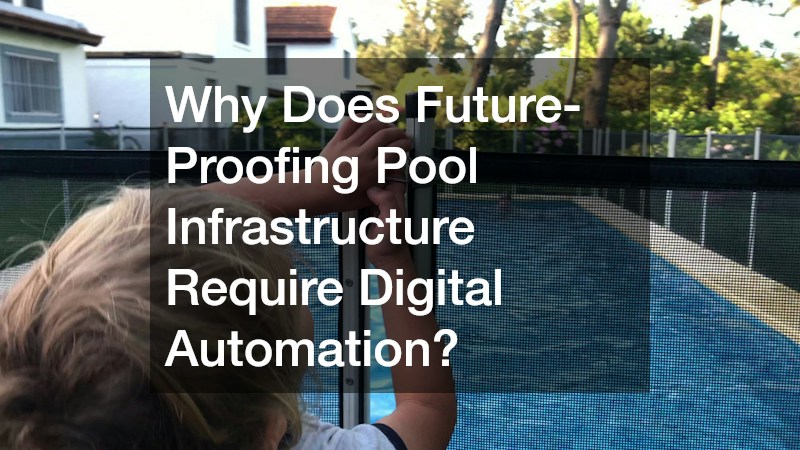
Why Does Future-Proofing Pool Infrastructure Require Digital Automation?
Modernizing pool infrastructure with digital automation delivers lasting operational efficiency, regulatory compliance, and unmatched protection for residential and commercial aquatic spaces. Municipal safety mandates and commercial liability standards continue to evolve, requiring precise digital record-keeping, verified maintenance routines, and strict perimeter controls.
Smart controllers effortlessly collect this compliance data, generating exportable digital audit logs that prove diligent oversight for insurance underwriters and municipal inspectors alike. Furthermore, cloud-managed systems scale alongside broader smart facility integrations, linking seamlessly with lighting grids, water quality monitors, and acoustic alarm networks. Upgrading from mechanical latches to an automated, intelligent barrier ecosystem replaces guesswork with real-time operational transparency, safeguarding lives and preserving your perimeter investment for years to come.
Upgrading perimeter security with smart access technology replaces the inherent vulnerabilities of mechanical locks with intelligent, verifiable oversight. By fusing real-time IoT monitoring, cryptographic credentials, and automated video verification, modern properties establish an impenetrable first line of aquatic safety. These interconnected systems provide property managers and homeowners with total situational awareness, eliminating the risks of human error and latches left ajar. Embracing digital access automation transforms your pool perimeter into a proactive, resilient barrier engineered to protect families and safeguard communities for decades to come.